Rosiglitazone (BRL 49653, AbMole, M1894) is a thiazolidinedione compound and a high-affinity agonist of peroxisome proliferator-activated receptor gamma (PPARγ). PPARγ is a key, ligand-activated transcription factor within the nuclear receptor superfamily, regulating gene expression involved in energy metabolism and cell differentiation. Rosiglitazone binds directly to the PPARγ ligand-binding domain to exert its biological effects by modulating downstream target genes [1, 2].
At the molecular level, Rosiglitazone (CAS No.: 122320-73-4) regulates inflammatory signaling like NF-κB and metabolic pathways including glucose transport and lipogenesis. For example, it reduces p65 phosphorylation and upregulates IκBα expression—an anti-inflammatory effect abolished upon PPARγ knockout, confirming its dependence on PPARγ activation. Recent studies also identify Rosiglitazone as a ligand for retinoid X receptor α (RXRα), regulating gene transcription via an RXRα-dependent pathway [3].
In cellular assays, Rosiglitazone demonstrates pleiotropic effects:
1.Inhibits proliferation: Suppresses cell cycle and induces apoptosis in a dose- and time-dependent manner, significantly reducing migration in 5637 and T24 cells [4].
2.Regulates mitochondrial function: Protects mitochondria, promotes oxidative phosphorylation, and increases intracellular ATP levels—effects reversed by the PPARγ antagonist GW9662 (AbMole, M2748) [5].
3.Modulates macrophage polarization: Inhibits M1 while promoting M2 macrophage polarization and enhances microglial phagocytosis, mediated by the PPARγ/CD36 axis [6].
4.Induces differentiation: Promotes lipid accumulation and differentiation of 3T3-L1 preadipocytes into adipocytes [7].
In vivo, Rosiglitazone reduces neurodamage in a mouse intracerebral hemorrhage model by inhibiting apoptosis via the PPARγ/JNK/STAT3 axis[8]. It also alleviates fibrosis progression in a mouse pulmonary fibrosis model by suppressing p38 MAPK phosphorylation [9].
AbMole provides global researchers with high-purity, high-bioactivity inhibitors, cytokines, human monoclonal antibodies, natural products, fluorescent dyes, peptides, compound libraries, antibiotics, and other research reagents, widely cited in numerous publications and patents worldwide.
Case Study
Adv Sci (Weinh). 2023 May;10(15):e2207224.
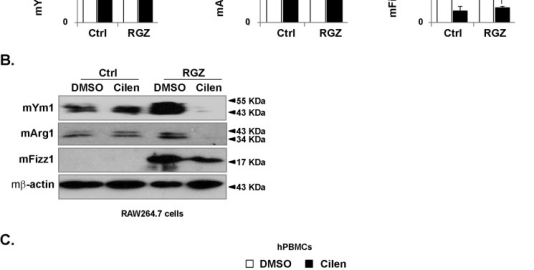
In the above study, researchers at Chongqing Medical University investigated how hypoxia drives biomaterial-induced heterotopic ossification (HO) by modulating macrophage polarization and osteoclastogenesis. The key finding is that the hypoxic environment promotes M2 polarization and lipid accumulation in macrophages via activation of hypoxia-inducible factor-1α (HIF-1α), which subsequently leads to macrophage fusion and osteoclast formation. The osteoclasts then secrete factors (such as CTHRC1 and S1P) that induce osteogenic differentiation of mesenchymal stem cells, ultimately resulting in heterotopic ossification. This mechanism provides new insights for the design of bone repair materials. Rosiglitazone (BRL 49653, AbMole, M1894), an M2 macrophage activator, was used as a positive control in this study to confirm the role of macrophage polarization in the above model.
In 2014, two AbMole inhibitors were used in in vivo studies by the Spanish National Center for Cardiovascular Research (CNIC) and Columbia University, leading to publications in Nature and Nature Medicine.
Cilengitide partially inhibited rosiglitazone-induced M2 polarization. (See Featured Image)
*The products mentioned herein are for research use only.
References and Acknowledgements
[1] C. Hu, H. L. Keen, K. T. Lu, et al., Retinol-binding protein 7 is an endothelium-specific PPARgamma cofactor mediating an antioxidant response through adiponectin, JCI insight 2(6) (2017) e91738.
[2] Q. Mu, Q. He, H. Zhou, et al., Rosiglitazone Promotes Microglial Distribution via Activation of PPARgamma and CD36 in the ICH Rat Model, Neuro endocrinology letters 45(2) (2024) 96-106.
[3] F. Huang, Y. Li, J. Chen, et al., Rosiglitazone binds to RXRalpha to induce RXRalpha tetramerization and NB4 cell differentiation, Biochemical and biophysical research communications 530(1) (2020) 160-166.
[4] X. Xu, J. Wang, H. Jiang, et al., Rosiglitazone induces apoptosis on human bladder cancer 5637 and T24 cell lines, International journal of clinical and experimental pathology 10(10) (2017) 10197-10204.
[5] J. M. Ortiz-Rodriguez, C. Balao da Silva, J. Masot, et al., Rosiglitazone in the thawing medium improves mitochondrial function in stallion spermatozoa through regulating Akt phosphorylation and reduction of caspase 3, PloS one 14(7) (2019) e0211994.
[6] Q. Mu, L. Wang, H. Hang, et al., Rosiglitazone pretreatment influences thrombin-induced phagocytosis by rat microglia via activating PPARgamma and CD36, Neuroscience letters 651 (2017) 159-164.
[7] Y. Wang, Z. Yang, Y. Li, et al., Impact of Rosiglitazone on Subdermal Adipose Tissue Growth and Lipid Droplet Formation: An In Vitro and In Vivo Study, Aesthetic plastic surgery (2025).
[8] C. Chao, Y. Li, Q. Li, et al., Inhibitory effect and mechanism of Rosiglitazone on M1 type polarization of central microglia in intracerebral hemorrhage mice based on JNK/STAT3 signaling pathway, Brain and behavior 13(12) (2023) e3275.
[9] H. Zhang, L. You, M. Zhao, Rosiglitazone attenuates paraquat-induced lung fibrosis in rats in a PPAR gamma-dependent manner, European journal of pharmacology 851 (2019) 133-143.