BAY 11-7082 (BAY 11-7821, M2040, AbMole) is a widely used NF-κB inhibitor applied in research on inflammatory responses, cancer, and immune regulation. BAY 11-7082 (CAS No.: 19542-67-7) selectively inhibits IκBα phosphorylation in the NF-κB pathway, thereby blocking IκBα degradation and NF-κB nuclear translocation, ultimately suppressing the transcription of NF-κB-dependent genes[1]. In addition to this classical pathway, BAY 11-7082 also inhibits the ubiquitin-specific proteases USP7 and USP21 (IC50: 0.19 μM and 0.96 μM, respectively) and interferes with ubiquitin-conjugating enzyme E2 activity. In RAS-mutant tumor cells, BAY 11-7082 significantly suppresses the growth of NRAS-, KRAS-, and HRAS-mutant tumor cells, an effect validated both in vitro and in mouse xenograft models[1]. Its molecular mechanisms include inhibition of the PI3K-AKT signaling pathway, activation of apoptotic pathways, and downregulation of multiple pro-survival genes [1]. In liver fibrosis research, BAY 11-7082 is used to inhibit activated hepatic stellate cells [2]. BAY 11-7082 also exhibits multiple protective effects in animal models of neurological disorders. For example, it inhibits TNF-α-induced astrocyte dedifferentiation via the NF-κB-Nanog-CD44/Musashi-1 signaling axis[3]; alleviates neuropathy and improves mitochondrial function in diabetic mouse models[4]; and in a postnatal rat model, it inhibits sevoflurane-induced hippocampal pyroptosis and neuroinflammation, preserving synaptic integrity and improving neurocognitive function[5]. In bone metabolism research, BAY 11-7082 is used to validate the regulatory role of the NF-κB pathway in osteogenic differentiation[6]. Thus, BAY 11-7082 is not only an essential tool compound for studying the NF-κB pathway but also demonstrates strong application potential in animal models of cancer, neurodegenerative diseases, fibrotic diseases, and metabolic diseases.
AbMole provides global researchers with high-purity, high-bioactivity inhibitors, cytokines, human monoclonal antibodies, natural products, fluorescent dyes, peptides, compound libraries, antibiotics, and other research reagents, widely cited in numerous publications and patents worldwide.
Case Study
J Inflamm Res. 2021 Mar 17;14:917-928.
Researchers from the State Key Laboratory of Bioelectronics at Southeast University developed a high-throughput visual screening platform for NF-κB inhibitors using three gene-edited tumor cell lines. Using TALEN and CRISPR technology, they edited five NF-κB family genes (RELA, RELB, CREL, NF-κB1, NF-κB2) in three cell lines (293T, HepG2, and PANC1) to enable ZsGreen fusion expression. BAY 11-7082 (M2040, BAY 11-7821) provided by AbMole was used as an NF-κB inhibitor to validate cellular responsiveness to NF-κB inhibition. In 2014, two inhibitors from AbMole were used in in vivo studies by the Spanish National Center for Cardiovascular Research (CNIC) and Columbia University, leading to publications in Nature and Nature Medicine.
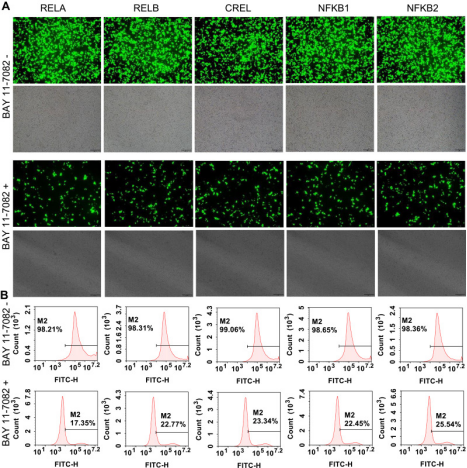
BAY 11-7082 treatment applied to flow cytometry-sorted positive cells [7].
References and Acknowledgments
[1] P. Guruvaiah, R. Gupta, IkappaBalpha kinase inhibitor BAY 11-7082 promotes anti-tumor effect in RAS-driven cancers, Journal of translational medicine 22(1) (2024) 642.
[2] Z. Cheng, F. Li, Y. Qie, et al., Hepatic Stellate Cell Membrane-Camouflaged Nanoparticles for Targeted Delivery of an Antifibrotic Agent to Hepatic Stellate Cells with Enhanced Antifibrosis Efficacy, Nano letters 24(49) (2024) 15827-15836.
[3] Z. Ding, C. Dai, W. Shan, et al., TNF-alpha up-regulates Nanog by activating NF-kappaB pathway to induce primary rat spinal cord astrocytes dedifferentiation, Life sciences 287 (2021) 120126.
[4] L. Sharan, A. Pal, S. S. Babu, et al., Bay 11-7082 mitigates oxidative stress and mitochondrial dysfunction via NLRP3 inhibition in experimental diabetic neuropathy, Life sciences 359 (2024) 123203.
[5] J. Dai, X. Li, C. Wang, et al., Repeated neonatal sevoflurane induced neurocognitive impairment through NF-kappaB-mediated pyroptosis, Journal of neuroinflammation 18(1) (2021) 180.
[6] S. Du, D. Yang, Q. Liu, et al., Ginkgolide B Alleviates LPS-Induced Inhibition of Osteogenic Differentiation in Human Periodontal Ligament Stem Cells by Suppressing the p-IkappaBalpha/NF-kappaB Pathway, Drug design, development and therapy 19 (2025) 8309-8326.
[7] S. Zhang, T. Luo, J. Wang, Stable Cells with NF-κB-ZsGreen Fused Genes Created by TALEN Editing and Homology Directed Repair for Screening Anti-inflammation Drugs, Journal of inflammation research 14 (2021) 917-928.