Tribromoethanol (AbMole, M5358) is an important compound in scientific research, particularly for anesthesia in laboratory animals. The mechanism of Tribromoethanol (Avertin) primarily involves central nervous system depression. Studies show that Tribromoethanol (CAS No.: 75-80-9) exerts its anesthetic effects by binding to the transmembrane domain (TMD) of the GABAA receptor and enhancing its activity[1]. GABA is a major inhibitory neurotransmitter in the CNS; enhancing its function reduces neuronal excitability, producing dose-dependent sedation and analgesia. Additionally, Tribromoethanol activates TASK-3 potassium channels and modulates neuronal membrane potential, contributing to anesthesia[2]. In rodent models (mice and rats), Tribromoethanol (Avertin) is typically administered intraperitoneally at doses ranging from 125 mg/kg to 500 mg/kg [3-5]. Onset of anesthesia is <5 minutes, with a duration of 30–50 minutes.
AbMole provides global researchers with high-purity, high-bioactivity inhibitors, cytokines, human monoclonal antibodies, natural products, fluorescent dyes, peptides, compound libraries, antibiotics, and other research reagents, as cited extensively in publications and patents worldwide.
Proper dissolution and preparation of Tribromoethanol (AbMole,M14641) are critical for successful research applications. The commonly used concentrations are 1.25% or 2.5%. For a 2.5% solution: first, dissolve Tribromoethanol powder in tert-amyl alcohol at a 1:1 (w/v) ratio, shaking thoroughly to obtain a clear stock solution. This stock must be immediately filter-sterilized through a 0.22 μm membrane to reduce the risk of peritonitis following intraperitoneal injection. Then, dilute the stock 1:40 with sterile saline to obtain a 2.5% working solution. Aseptic technique must be maintained throughout. The working solution is light- and air-sensitive; store at 2–8°C protected from light in foil-wrapped or brown bottles. Before use, allow the solution to reach room temperature and ensure complete dissolution without crystals. Pre-experiments are strongly recommended to determine the optimal dose. For mice, the typical IP dose of 2.5% working solution is 15–20 µL/g body weight, but dose titration should account for age, strain, and model. The above procedure is a key factor for Tribromoethanol to exert its anesthetic effect.
Additionally, sterile ready-to-use Avertin (Tribromoethanol for ready use, M5358, AbMole) is available for direct IP injection without complex preparation. For ready-to-use formulations, the recommended anesthetic dose is 30 µL/g for mice and 25 mL/kg for rats. Dose may vary slightly by strain and age; pre-experiments with a dose range of 20–30 µL/g are advised to determine the final dose. After aseptic aliquoting, store at 2–8°C protected from light for up to 1 year, or at room temperature for up to 3 months. If crystallization occurs, allow to return to room temperature (may be warmed to 30°C) to redissolve completely before use. In 2014, two inhibitors from AbMole were used in in vivo studies by the Spanish National Center for Cardiovascular Research (CNIC) and Columbia University, leading to research publications in Nature and Nature Medicine.
Case Study
Stem Cell Res Ther. 2025 Sep 26;16(1):511.
Researchers from the Shandong Stem Cell Engineering Technology Research Center reported that human umbilical cord mesenchymal stem cells (hUC-MSCs) repair cisplatin (CDDP)-induced blood-testis barrier (BTB) damage and restore reproductive function in mice by inhibiting ferroptosis. Following intraperitoneal CDDP injection, mice exhibited abnormal testicular morphology, disorganized seminiferous tubules, reduced sperm count and motility, increased BTB permeability, downregulated BTB-related proteins, and altered ferroptosis markers. Tail vein injection of hUC-MSCs 24 hours after CDDP reversed these effects; the ferroptosis inhibitor Fer-1 mimicked this protection. In vitro fertilization assays showed normalized embryo formation rates in the hUC-MSCs-treated group. In these animal experiments, researchers used ready-to-use 2,2,2-Tribromoethanol (Avertin, AbMole, M2223) as an anesthetic. On day 14, mice were anesthetized with an intraperitoneal dose of 240 mg/kg. Tribromoethanol minimized animal distress, complied with ethical standards, and enabled reliable collection of testicular, epididymal, and sperm samples without tissue damage, which was critical for subsequent histological analysis, protein detection, and sperm quality assessment [6].
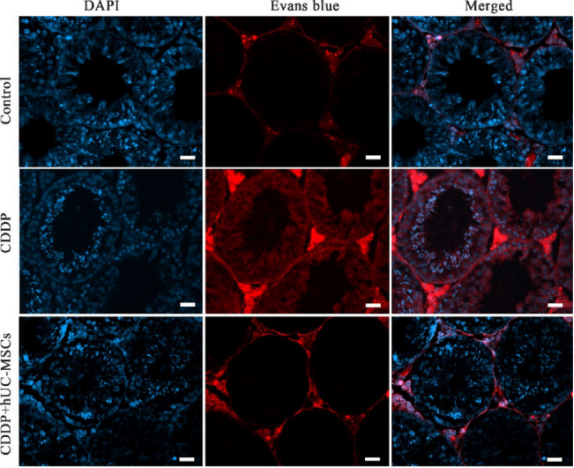
Evans blue permeability assay for BTB integrity. Blue fluorescence indicates DAPI-stained nuclei, while red fluorescence corresponds to Evans blue staining
References and Acknowledgments
[1] Q. Chen, M. M. Wells, T. S. Tillman, et al., Structural Basis of Alcohol Inhibition of the Pentameric Ligand-Gated Ion Channel ELIC, Structure (London, England : 1993) 25(1) (2017) 180-187.
[2] A. Luethy, J. D. Boghosian, R. Srikantha, et al., Halogenated Ether, Alcohol, and Alkane Anesthetics Activate TASK-3 Tandem Pore Potassium Channels Likely through a Common Mechanism, Molecular pharmacology 91(6) (2017) 620-629.
[3] Robert E Meyer, Richard E %J Lab animal Fish, A review of tribromoethanol anesthesia for production of genetically engineered mice and rats, 34(10) (2005) 47-52.
[4] William A Hill, Jacquelyn T Tubbs, Christopher L Carter, et al., Repeated administration of tribromoethanol in C57BL/6NHsd mice, 52(2) (2013) 176-179.
[5] Arlene McDowell, Jessica A. Fothergill, Azeem Khan, et al., A cyclodextrin formulation to improve use of the anesthetic tribromoethanol (Avertin®), Journal of Pharmacy and Bioallied Sciences 6(1) (2014).
[6] X. Liu, X. Wang, X. Zhang, et al., Human umbilical cord mesenchymal stem cells ameliorates cisplatin-induced blood-testis barrier dysfunction in mice by mitigating ferroptosis, Stem cell research & therapy 16(1) (2025) 511.