XAV939 (NVP-XAV939, AbMole, M1796) is a small-molecule inhibitor targeting Tankyrase (TNKS1/2) that regulates the Wnt/β-catenin signaling pathway. Studies have shown that XAV939 (CAS No.: 284028-89-3) inhibits Tankyrase activity, stabilizes Axin (a key component of the β-catenin degradation complex), promotes β-catenin degradation, and ultimately suppresses the transcriptional activity of the canonical Wnt signaling pathway[1]. Notably, the effects of XAV939 extend beyond Wnt pathway regulation; in cell differentiation research, it also influences cell fate determination by inhibiting YAP activation (a co-activator of TEAD transcription factors). Consequently, XAV939 has important applications in stem cell and organoid research. For example, in neural differentiation studies, XAV939 combined with CHIR99021 (a GSK-3β inhibitor) synergistically regulates β-catenin levels and the neural differentiation potential of stem cells[2]. XAV939 combined with IWP2 improves cardiomyocyte differentiation efficiency[3]. XAV939 also maintains organoid homeostasis by regulating the WNT signaling pathway, and is a key component of culture media, particularly for neural organoids. Furthermore, XAV939 exhibits anti-proliferative activity in cancer research by inhibiting β-catenin nuclear accumulation in tumor cells and affecting the expression of downstream target genes such as TCF12 and caveolin-1[4]. In the field of metabolic regulation, XAV939 treatment improves insulin sensitivity in rats and mice by modulating the expression of GLUT4 vesicle-associated proteins (e.g., RAB10, VAMP8)[5].
AbMole provides global researchers with high-purity, high-bioactivity inhibitors, cytokines, human monoclonal antibodies, natural products, fluorescent dyes, peptides, compound libraries, antibiotics, and other research reagents, widely cited in numerous publications and patents worldwide.
Case Study
Pharmacol Res. 2020 Jul;157:104831.
Researchers at Anhui University of Chinese Medicine investigated the molecular mechanisms by which Astragaloside IV (AS-IV) ameliorates diabetic nephropathy (DN) in a rat model. They found that AS-IV exhibits favorable pharmacokinetic properties in rats and acts through 26 related targets and multiple DN-associated signaling pathways, including Wnt and PI3K/Akt. AS-IV exerts antioxidant, anti-inflammatory, and anti-epithelial-mesenchymal transition (EMT) effects, ultimately reducing serum creatinine (Scr), blood urea nitrogen (BUN), and proteinuria levels, and alleviating glomerulosclerosis, interstitial fibrosis, and kidney injury in the DN rat model. XAV939 (NVP-XAV939, AbMole, M1796) provided by AbMole was used as a specific inhibitor of the Wnt/β-catenin signaling pathway and served as a positive control in the study. Western blot comparisons with the AS-IV treatment group confirmed the regulatory activity of AS-IV on the Wnt/β-catenin signaling pathway.
In 2014, two inhibitors from AbMole were used in in vivo studies by the Spanish National Center for Cardiovascular Research (CNIC) and Columbia University, leading to publications in Nature and Nature Medicine.
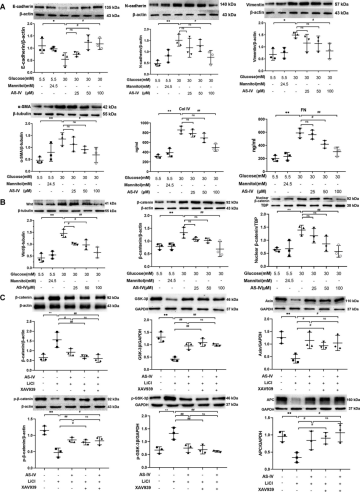
Effects of AS-IV on EMT and ECM proteins in high glucose-injured HK-2 cells[6]
References and Acknowledgments
[1] J. Suebsoonthron, T. Jaroonwitchawan, M. Yamabhai, et al., Inhibition of WNT signaling reduces differentiation and induces sensitivity to doxorubicin in human malignant neuroblastoma SH-SY5Y cells, Anti-cancer drugs 28(5) (2017) 469-479.
[2] M. Telias, D. Ben-Yosef, Pharmacological Manipulation of Wnt/beta-Catenin Signaling Pathway in Human Neural Precursor Cells Alters Their Differentiation Potential and Neuronal Yield, Frontiers in molecular neuroscience 14 (2021) 680018.
[3] G. H. Hwang, S. M. Park, H. J. Han, et al., Purification of small molecule-induced cardiomyocytes from human induced pluripotent stem cells using a reporter system, Journal of cellular physiology 232(12) (2017) 3384-3395.
[4] F. Luo, J. Li, J. Liu, et al., Stabilizing and upregulating Axin with tankyrase inhibitor reverses 5-fluorouracil chemoresistance and proliferation by targeting the WNT/caveolin-1 axis in colorectal cancer cells, Cancer gene therapy 29(11) (2022) 1707-1719.
[5] K. Manglani, C. S. Dey, Tankyrase inhibition augments neuronal insulin sensitivity and glucose uptake via AMPK-AS160 mediated pathway, Neurochemistry international 141 (2020) 104854.
[6] E. Wang, L. Wang, R. Ding, et al., Astragaloside IV acts through multi-scale mechanisms to effectively reduce diabetic nephropathy, Pharmacological research 157 (2020) 104831.